
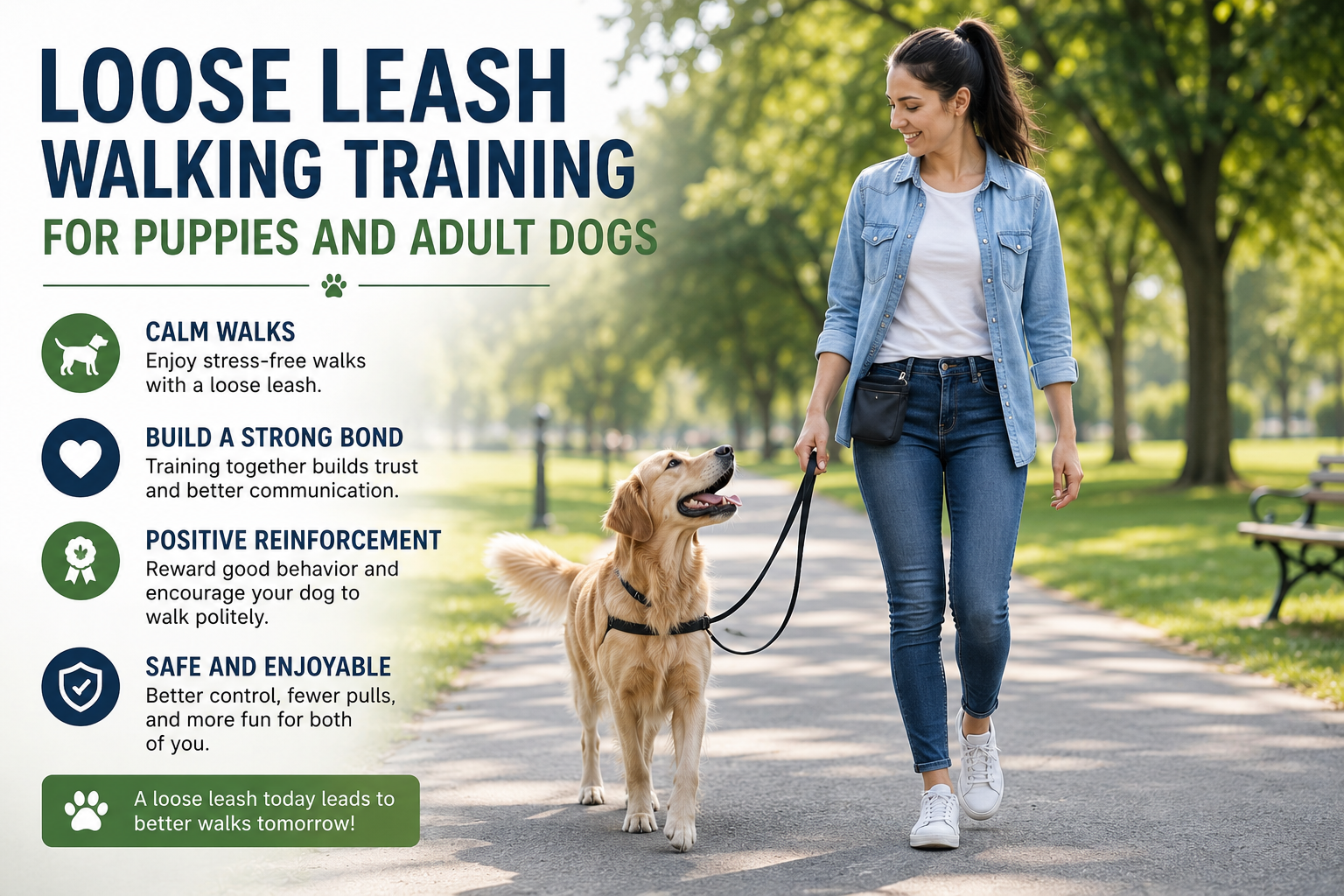
Loose Leash Walking Training for Puppies and Adult Dogs – Walking your dog should be an enjoyable experience for both of you. Unfortunately, many dog owners struggle with pulling, lunging, and constant tension on the leash. Whether you have an energetic puppy or an adult dog with established habits, loose leash walking training can transform daily walks into calm, enjoyable outings.
Loose leash walking means your dog walks beside you or near you without pulling on the leash. The leash remains relaxed, allowing both dog and owner to move comfortably and safely. While it may seem like a simple skill, teaching a dog to walk politely on a leash requires patience, consistency, and positive reinforcement.
This guide explains everything you need to know about loose leash walking training for puppies and adult dogs, including why dogs pull, effective training methods, common mistakes, and tips for long-term success.
What Is Loose Leash Walking?
Loose leash walking is the ability of a dog to walk without creating tension on the leash. Unlike formal heel training, which requires a dog to stay in a precise position beside the handler, loose leash walking allows your dog more freedom to explore while remaining under control.
The goal is simple:
- No pulling
- No dragging the owner
- No constant leash tension
- Safe and enjoyable walks
A dog can sniff, explore, and enjoy the environment while maintaining a loose leash.
Why Do Dogs Pull on the Leash?
Understanding why dogs pull is the first step toward solving the problem.
Dogs Naturally Walk Faster
Most dogs naturally move faster than humans. When they want to reach something interesting, they instinctively move ahead.
Excitement and Curiosity
The outside world is full of exciting sights, sounds, smells, and experiences. Dogs often pull because they are eager to investigate.
Accidental Reinforcement
Many owners unintentionally reward pulling.
For example, when a dog pulls toward a tree and successfully reaches it, the dog learns that pulling works. Every successful pull reinforces the behavior.
Lack of Training
Dogs are not born knowing how to walk politely on a leash. Without guidance, pulling often becomes a habit.
Benefits of Loose Leash Walking Training
Teaching your dog to walk calmly offers numerous benefits.
Improved Safety
A dog that pulls can create dangerous situations around traffic, cyclists, and other animals.
Better Control
You gain more control over your dog’s movements in busy environments.
Reduced Stress
Walks become more enjoyable and less physically demanding for both owner and dog.
Stronger Bond
Training sessions help strengthen communication and trust between you and your dog.
Better Exercise Experience
Instead of constantly correcting your dog, you can focus on enjoying quality time together.
Training Puppies for Loose Leash Walking
Puppies are often easier to train because they have not yet developed strong pulling habits.
Start Indoors
Begin training in a quiet environment with minimal distractions.
Attach the leash and allow your puppy to become comfortable wearing it.
Walk a few steps.
When your puppy follows without pulling, immediately reward with:
- Treats
- Praise
- Gentle affection
Repeat frequently.
Reward the Desired Position
Every time your puppy walks beside you with a loose leash, provide positive reinforcement.
Your puppy should learn that staying close to you leads to rewards.
Use Short Sessions
Puppies have limited attention spans.
Keep sessions between 5 and 10 minutes.
Several short sessions are often more effective than one long session.
Gradually Increase Distractions
Once your puppy succeeds indoors, move to:
- Backyard
- Quiet streets
- Parks
- More challenging environments
Increase difficulty gradually to build confidence.
Training Adult Dogs for Loose Leash Walking
Adult dogs can absolutely learn loose leash walking, even if they have pulled for years.
The process may require more patience because existing habits must be replaced.
Reset Expectations
Do not assume your dog already knows how to walk politely simply because it is older.
Treat loose leash walking as a completely new skill.
Return to Basics
Start in low-distraction environments.
Practice the same exercises used for puppies:
- Reward loose leash behavior
- Stop when pulling occurs
- Reinforce calm walking
Be Consistent
Consistency is especially important for adult dogs.
If pulling occasionally works, progress will be slower.
Every family member should follow the same rules.
The Stop-and-Go Method
One of the most effective loose leash training techniques is the stop-and-go method.
How It Works
- Begin walking.
- The moment your dog pulls, stop immediately.
- Stand still and remain silent.
- Wait until the leash becomes loose.
- Resume walking.
The dog learns an important lesson:
Pulling stops the walk.
Only a loose leash allows movement forward.
Why It Works
Dogs pull because they want to move forward.
When forward progress disappears, pulling loses its reward.
Over time, the dog chooses loose leash behavior instead.
The Change-of-Direction Method
Another highly effective technique involves changing direction whenever pulling occurs.
Steps
- Walk normally.
- When your dog pulls, turn and walk in the opposite direction.
- Encourage your dog to follow.
- Reward when the leash becomes loose.
This method teaches your dog to pay attention to your movements rather than leading the walk.
Using Positive Reinforcement
Positive reinforcement is the foundation of successful leash training.
Reward behaviors you want repeated.
Examples include:
- Walking beside you
- Checking in visually
- Responding to your direction
- Maintaining a loose leash
Rewards may include:
- Small treats
- Verbal praise
- Favorite toys
- Opportunities to sniff
Many dogs find sniffing highly rewarding.
You can use sniffing as a reward by allowing your dog to investigate an interesting area after several moments of good walking.
Common Training Mistakes
Pulling Back on the Leash
Many owners respond to pulling by pulling back.
This often creates a natural opposition reflex, causing dogs to pull harder.
Inconsistent Rules
Allowing pulling sometimes but correcting it at other times confuses dogs.
Consistency is critical.
Moving Too Fast
Advancing to highly distracting environments too quickly can overwhelm your dog.
Progress gradually.
Lack of Rewards
Many owners stop rewarding too early.
Continue reinforcing good behavior even after your dog improves.
Long Training Sessions
Mental fatigue can reduce learning.
Keep sessions manageable and positive.
Choosing the Right Equipment
Proper equipment can make training easier.
Standard Flat Collar
Suitable for many dogs when used correctly.
Front-Clip Harness
Front-clip harnesses can reduce pulling and provide better control during training.
Comfortable Leash
A leash between 4 and 6 feet is generally ideal for training purposes.
Avoid retractable leashes during training because they often encourage pulling.
Handling Common Challenges
Excitement Around Other Dogs
Increase distance from distractions.
Reward calm behavior before your dog becomes overly excited.
Strong Sniffing Habits
Allow structured sniffing breaks.
Dogs need opportunities to explore their environment.
Pulling Near Home
Many dogs become excited at the beginning or end of walks.
Practice calm behavior before leaving and before returning home.
How Long Does Training Take?
Every dog learns at a different pace.
Factors include:
- Age
- Breed
- Temperament
- Training history
- Consistency
Some puppies show improvement within a few weeks.
Adult dogs with long-established habits may require several months of consistent practice.
The key is persistence.
Maintaining Good Leash Manners
Once your dog masters loose leash walking, continue practicing regularly.
Maintain occasional rewards and positive reinforcement.
Remember that training is not a one-time event. It is an ongoing process that strengthens communication between you and your dog throughout life.
Final Thoughts
Loose leash walking training is one of the most valuable skills a dog can learn. Whether you are working with a young puppy or an adult dog, teaching calm leash manners improves safety, strengthens your relationship, and makes every walk more enjoyable.
By using positive reinforcement, remaining consistent, and practicing regularly, you can help your dog understand that walking on a loose leash is both rewarding and enjoyable. With patience and dedication, even dogs with strong pulling habits can learn to walk calmly and confidently by your side.