
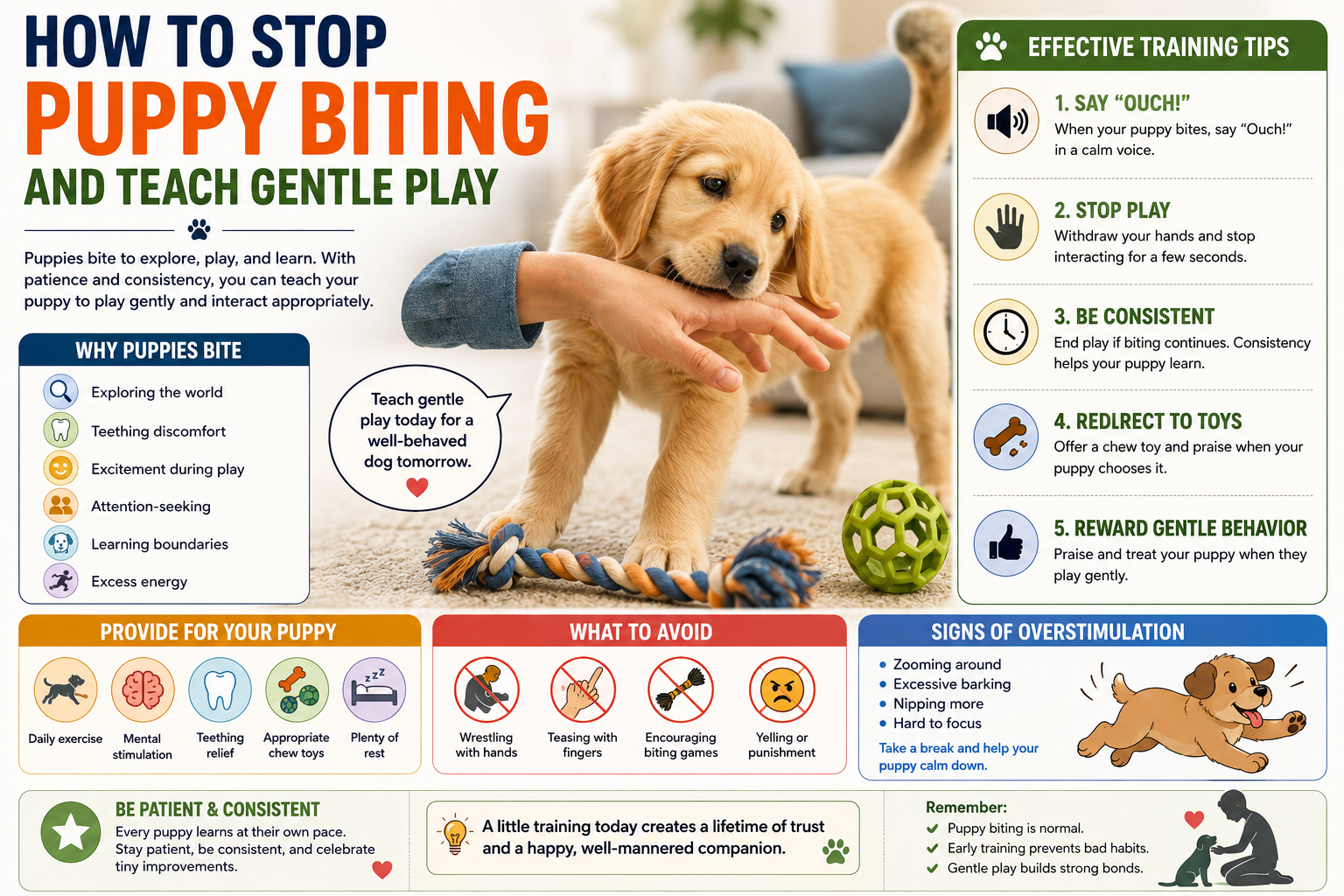
How to Stop Puppy Biting and Teach Gentle Play – Puppies are adorable, playful, and full of energy. However, one behavior that often surprises new dog owners is biting. Tiny puppy teeth may seem harmless at first, but repeated nipping, mouthing, and biting can quickly become frustrating and even painful. Fortunately, puppy biting is a normal part of development, and with the right training approach, you can teach your puppy to play gently and interact appropriately with people.
Understanding why puppies bite and how to respond effectively is essential for raising a well-behaved adult dog. This guide explains the causes of puppy biting, proven training techniques, common mistakes to avoid, and how to encourage gentle play from an early age.
Why Do Puppies Bite?
Before trying to stop puppy biting, it’s important to understand why it happens.
Puppies explore the world with their mouths. Just as human babies use their hands to investigate objects, puppies often use their teeth.
Biting can occur for several reasons:
- Exploration and curiosity
- Teething discomfort
- Excitement during play
- Attention-seeking behavior
- Learning social boundaries
- Excess energy
In most cases, puppy biting is not aggression. It is a normal developmental behavior that can be redirected and managed through training.
Understanding Puppy Mouthing
Mouthing refers to a puppy gently using its mouth to interact with people or objects.
Many puppies mouth hands, clothing, shoes, and toys during play.
While mouthing is normal, it is important to teach puppies that human skin is not an appropriate chew toy.
Early training helps prevent mouthing from becoming a long-term habit.
The Role of Bite Inhibition
One of the most important lessons puppies learn is bite inhibition.
Bite inhibition is a dog’s ability to control the force of its bite.
Puppies typically begin learning this skill while interacting with their littermates. If one puppy bites too hard, the other puppy often yelps and stops playing.
This teaches the biting puppy that rough behavior ends the fun.
Owners can use a similar concept to teach gentle play at home.
Stay Calm and Consistent
When your puppy bites, avoid reacting with anger or frustration.
Yelling, hitting, or using harsh punishment can create fear and damage trust.
Instead:
- Stay calm
- Respond consistently
- Redirect behavior appropriately
Puppies learn best through clear and predictable guidance.
Use the “Ouch” Method
One common training technique involves mimicking how littermates respond to painful bites.
When your puppy bites too hard:
- Say “Ouch!” in a calm but noticeable tone.
- Immediately stop interacting.
- Withdraw your hands.
- Pause play for several seconds.
This helps your puppy understand that biting causes playtime to stop.
Some puppies respond well to this method, while others may become more excited. Observe your puppy’s reaction and adjust accordingly.
End Play When Biting Continues
If your puppy continues biting after a warning, briefly end the interaction.
Stand up and walk away.
Ignore the puppy for 20 to 30 seconds before resuming play.
This teaches an important lesson:
Gentle behavior keeps play going. Rough behavior makes play stop.
Consistency is key.
Redirect to Appropriate Toys
One of the most effective ways to reduce puppy biting is redirection.
Whenever your puppy begins chewing on your hands, clothing, or furniture, immediately offer a suitable toy.
Examples include:
- Rubber chew toys
- Teething toys
- Rope toys
- Soft puppy-safe toys
Praise your puppy when they choose the toy instead of your hands.
Over time, your puppy learns what is appropriate to chew.
Manage Teething Discomfort
Most puppies begin teething between three and six months of age.
During this period, chewing helps relieve discomfort.
Provide safe chewing options such as:
- Puppy teething toys
- Rubber chew products
- Vet-approved chew items
Some toys can be chilled to provide additional relief.
Meeting your puppy’s chewing needs can significantly reduce biting behavior.
Encourage Gentle Play
Teaching gentle play requires rewarding the behaviors you want to see.
During play sessions:
- Reward calm interactions
- Praise soft mouth behavior
- Reinforce appropriate toy use
- Stop rough play immediately
Positive reinforcement helps puppies understand what earns attention and rewards.
Teach Basic Commands
Simple obedience training can help redirect a puppy’s focus.
Useful commands include:
Sit
Asking for a sit before play encourages self-control.
Leave It
This command teaches your puppy to disengage from inappropriate objects or behaviors.
Drop It
Helpful for releasing items and reducing possessive behaviors.
Come
A reliable recall command allows you to redirect your puppy away from situations that encourage biting.
Training sessions also provide valuable mental stimulation.
Ensure Adequate Exercise
A tired puppy is often a better-behaved puppy.
Many biting problems are linked to excess energy.
Provide daily opportunities for:
- Walks
- Play sessions
- Training exercises
- Interactive games
Physical activity helps reduce frustration and promotes calm behavior.
Provide Mental Stimulation
Mental enrichment is just as important as physical exercise.
Bored puppies often create their own entertainment through chewing and biting.
Helpful activities include:
- Puzzle toys
- Food-dispensing toys
- Scent games
- Basic obedience training
- Interactive play
Mental stimulation helps satisfy a puppy’s natural curiosity.
Avoid Rough Play
Games that encourage biting can unintentionally reinforce unwanted behavior.
Avoid activities such as:
- Wrestling with your hands
- Allowing puppies to chase fingers
- Encouraging biting games
- Teasing with clothing
Instead, use toys as the focus of interactive play.
This teaches appropriate boundaries.
Prevent Overstimulation
Many puppies become mouthy when they are overly excited.
Signs of overstimulation include:
- Zooming around the room
- Barking excessively
- Increased nipping
- Difficulty focusing
If your puppy becomes overly excited, provide a calm break and allow them to settle.
Short rest periods can help prevent unwanted behavior.
Common Mistakes to Avoid
Using Physical Punishment
Physical corrections can increase fear and anxiety while damaging trust.
Inconsistency
If one family member allows biting while another discourages it, training becomes confusing.
Everyone should follow the same rules.
Expecting Immediate Results
Puppies need time to learn.
Consistent training over weeks and months produces the best outcomes.
Ignoring Positive Behavior
Many owners focus only on correcting mistakes.
Remember to reward calm and gentle interactions frequently.
When Is Puppy Biting a Concern?
Most puppy biting is completely normal.
However, consult a veterinarian or professional trainer if:
- Biting appears aggressive rather than playful
- Growling accompanies frequent biting
- Resource guarding develops
- Behavior worsens significantly with age
- The puppy causes repeated injuries
Professional guidance can help identify underlying issues and create a personalized training plan.
How Long Does It Take to Stop Puppy Biting?
Every puppy develops at a different pace.
Factors that influence progress include:
- Age
- Breed
- Consistency of training
- Teething stage
- Energy level
- Individual temperament
Most puppies show significant improvement by six months of age when training is consistent.
Patience is essential.
Remember that learning appropriate behavior is a gradual process.
Building Lifelong Good Habits
The goal is not simply to stop biting but to teach your puppy how to interact appropriately with people.
By focusing on:
- Positive reinforcement
- Redirection
- Consistency
- Mental stimulation
- Appropriate play
you create habits that will benefit your dog throughout adulthood.
A well-trained puppy grows into a confident, respectful companion who understands how to engage safely with family members and visitors.
Final Thoughts
Puppy biting is a normal part of growing up, but it should not be ignored. Early training helps puppies learn bite inhibition, self-control, and appropriate ways to play with people. Through positive reinforcement, toy redirection, gentle guidance, and consistent boundaries, owners can successfully reduce biting behavior and encourage healthy social skills.
Teaching gentle play takes time, patience, and repetition, but the effort is well worth it. By helping your puppy understand the difference between acceptable and unacceptable behavior, you lay the foundation for a happy, well-mannered, and confident adult dog.