
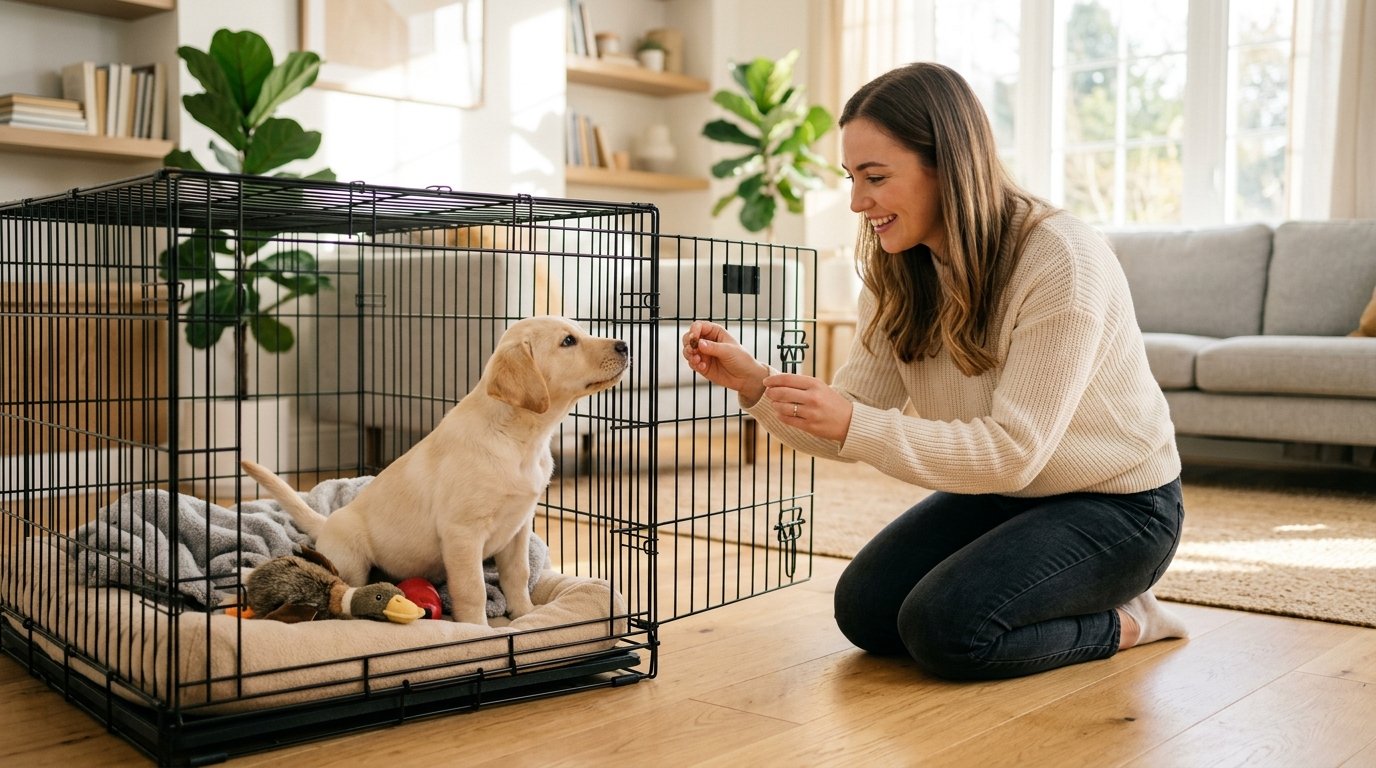
Crate Training for Puppies Made Easy for New Owners – Bringing home a new puppy is exciting, but it also comes with plenty of challenges. One of the most useful skills new owners can teach is crate training. When introduced correctly, a crate can become a comfortable, secure space where a puppy can rest, sleep, and relax.
Crate training is not about locking a puppy away or using confinement as punishment. Instead, it teaches puppies how to feel safe in their own space while helping owners establish routines for sleeping, house training, travel, and everyday life.
For new owners, the process may seem difficult at first. Puppies can whine, bark, resist entering the crate, or have accidents inside. However, with patience and positive reinforcement, most puppies can gradually learn to enjoy their crate.
What Is Crate Training?
Crate training is the process of teaching a puppy to voluntarily enter and remain comfortable inside a crate for appropriate periods of time. The crate should function as a safe resting area rather than a punishment zone.
Dogs naturally appreciate having a comfortable place where they can retreat and rest. A properly sized crate can provide that feeling of security while giving puppies a predictable environment.
A crate can also help new owners manage daily routines. Puppies often need frequent naps, regular bathroom breaks, and supervised activity. Having a safe place for rest can prevent them from getting into dangerous situations when owners cannot watch them every second.
Why Crate Training Is Important for Puppies
One major benefit of crate training is that it can support house training. Puppies generally prefer not to eliminate where they sleep, although very young puppies may not have enough bladder control to avoid accidents.
Using a crate alongside a consistent bathroom schedule can help puppies learn when and where they should go potty.
Crates can also prevent destructive behavior. Curious puppies may chew electrical cables, furniture, shoes, or other household objects. A crate provides a secure location when direct supervision is temporarily impossible.
Another advantage is easier travel. Puppies accustomed to crates are often more comfortable during car trips, hotel stays, veterinary visits, and other unfamiliar situations.
Perhaps most importantly, successful crate training can help puppies develop healthy independence. They learn that being alone for short, appropriate periods does not necessarily mean something bad will happen.
Choosing the Right Crate
Choosing the correct crate is an important first step. The crate should be large enough for the puppy to stand up, turn around, lie down comfortably, and stretch out.
However, avoid choosing a crate that is excessively large for a young puppy. If there is too much unused space, some puppies may use one area as a bathroom and another as a sleeping area.
Many crates come with adjustable dividers. These allow owners to start with a smaller space and gradually increase the available room as the puppy grows.
There are several common crate types, including wire crates, plastic travel crates, and soft-sided crates. Wire crates provide excellent ventilation and visibility, while plastic crates can provide a more enclosed environment. Soft crates may be convenient for travel but are generally better suited to puppies that have already learned not to chew or damage their surroundings.
Comfort is also important. Add a washable mat or appropriate bedding, but make sure the puppy does not chew and swallow pieces of it.
Where Should You Put the Crate?
Location can make a significant difference in how comfortable a puppy feels.
During the first few nights, placing the crate near your bed can help the puppy feel less isolated. Hearing and smelling you nearby may reduce anxiety and make nighttime bathroom trips easier.
During the daytime, the crate can be placed in an area where the family spends time. This allows the puppy to rest without feeling completely separated from everyone.
Avoid placing the crate somewhere excessively hot, cold, noisy, or isolated. The goal is to create a calm environment where the puppy can relax.
Introduce the Crate Slowly
One of the biggest mistakes new owners make is rushing the process.
Never force a puppy into the crate and immediately close the door for a long period. That can create fear and make future training more difficult.
Instead, begin by making the crate interesting.
Leave the door open and place a few treats or toys near the entrance. Allow the puppy to investigate at its own pace. Reward curiosity and calm behavior.
Next, place treats just inside the crate. When the puppy walks inside, offer praise and another reward.
Gradually move the treats farther toward the back. The puppy should begin associating the crate with positive experiences.
At this stage, there is no need to close the door. The primary goal is simply to teach the puppy that entering the crate is safe and rewarding.
Teach Your Puppy a Crate Cue
Once your puppy willingly enters the crate, introduce a simple verbal cue such as “crate,” “kennel,” or “bed.”
Say the cue immediately before encouraging the puppy to enter. When the puppy goes inside, provide praise or a small treat.
Repeat this process regularly.
Eventually, your puppy should understand that the cue means entering the crate leads to something positive. Keep training sessions short and relaxed rather than repeating the command excessively.
Start Closing the Door
After the puppy is comfortable entering the crate, begin closing the door for very short periods.
For example, give your puppy a safe chew or food toy while inside, close the door for a few seconds, then open it before the puppy becomes distressed.
Gradually increase the duration.
The important principle is to progress at the puppy’s pace. If the puppy immediately begins panicking whenever the door closes, the training has moved too quickly.
Return to shorter periods and create more positive experiences.
Use Treats and Toys Wisely
Positive reinforcement is one of the most effective tools for crate training.
Treats can reward entering the crate, remaining calm, lying down, or settling quietly. Food-stuffed toys can also make crate time more enjoyable.
For example, a puppy may receive a special chew toy only while relaxing in the crate. Over time, the puppy can begin to view crate time as an opportunity to enjoy something rewarding.
Avoid using high-value treats in a way that causes the puppy to become frustrated or possessive. Supervise new toys and chews until you are confident they are safe for your puppy.
Crate Training and House Training
Crate training can support potty training, but it does not eliminate the need for frequent bathroom breaks.
Young puppies have small bladders and limited control. They may need to go outside after waking, eating, drinking, playing, and exercising.
A practical routine is to take the puppy to the designated bathroom area immediately after leaving the crate.
When the puppy eliminates in the correct place, reward it promptly with praise and an appropriate treat.
Accidents will happen. When they do, avoid punishment. Yelling or physically correcting a puppy can create fear without teaching the desired behavior.
Instead, clean the area thoroughly and adjust the bathroom schedule if accidents are happening frequently.
Crate Training at Night
Nighttime can be one of the hardest parts of crate training for new owners.
A young puppy may cry because it is unfamiliar with the new environment, misses its mother and littermates, or needs to use the bathroom.
Keeping the crate near your bed initially can make nighttime easier. If the puppy wakes after several hours, take it calmly outside for a bathroom break and then return it to the crate.
Keep nighttime bathroom trips boring and quiet. Avoid turning them into play sessions.
As the puppy becomes more comfortable and develops better bladder control, nighttime interruptions should gradually decrease.
What to Do When Your Puppy Whines
Whining is common during crate training, but owners need to understand why the puppy is vocalizing.
The puppy may need to go to the bathroom, may be uncomfortable, may be frightened, or may simply be protesting because it wants attention.
If the puppy has recently eaten, drunk water, played, or slept, a bathroom break may be appropriate.
However, immediately opening the crate every time the puppy whines can teach it that crying makes the door open.
Try to distinguish genuine needs from attention-seeking behavior. If the puppy is safe, comfortable, and has recently gone to the bathroom, wait for a brief moment of calm before rewarding or releasing it.
Never leave a puppy in severe distress simply to follow a training rule. Excessive panic indicates that the training needs to be adjusted.
Common Crate Training Mistakes
New owners can accidentally make crate training harder through several common mistakes.
Using the Crate as Punishment
Never send a puppy into the crate angrily because it misbehaved. The crate should remain associated with safety and relaxation.
Leaving the Puppy Inside Too Long
A crate is not a substitute for exercise, interaction, training, and bathroom breaks. Puppies need regular opportunities to move, play, explore, and socialize.
Moving Too Quickly
Expecting a puppy to remain quietly crated for hours after only one day of training is unrealistic. Build duration gradually.
Opening the Door During Every Whining Episode
Constantly rewarding whining with immediate freedom can reinforce the behavior. Instead, respond appropriately based on the puppy’s needs.
Ignoring Exercise
A puppy with excess energy may struggle to settle inside the crate. Age-appropriate exercise and mental stimulation can make relaxation easier.
Choosing the Wrong Crate Size
A crate that is too small is uncomfortable, while one that is excessively large can complicate house training.
How Long Can a Puppy Stay in a Crate?
The appropriate amount of crate time depends on the puppy’s age, bladder control, temperament, training progress, and individual needs.
Very young puppies generally need frequent bathroom breaks and should not be expected to remain confined for long periods.
As puppies mature, they can gradually handle longer periods of rest. However, even adult dogs should not spend most of the day confined to a crate.
Think of the crate as one part of a balanced daily routine. Puppies need time outside the crate for exercise, training, social interaction, exploration, and bathroom breaks.
Make the Crate Part of Everyday Life
Crate training becomes easier when it is integrated naturally into the puppy’s routine.
For example, a puppy might spend time in the crate after a morning play session, during a daytime nap, or while the owner prepares a meal.
The crate should not only appear when the owner leaves the house. If it is used exclusively before departures, the puppy may begin associating it with being left alone.
Instead, practice short crate sessions while you are still at home.
This teaches the puppy that entering the crate does not always mean separation.
When to Stop Using the Crate
There is no universal age when every puppy should stop using a crate.
Some dogs continue to enjoy their crates throughout adulthood. Others eventually prefer sleeping on a dog bed or another comfortable location.
The important factor is behavior and maturity.
If your dog can remain loose in the house without destructive behavior, excessive accidents, or dangerous chewing, you can gradually experiment with giving it more freedom.
Start with short periods and expand access slowly.
Even after your dog no longer needs the crate for management, keeping it available can be beneficial. A familiar crate can provide a comfortable retreat during travel, visitors, storms, or other stressful situations.
Tips for Successful Crate Training
Consistency is one of the most important elements of successful crate training.
Use the same verbal cues and maintain predictable routines. Reward calm behavior and avoid turning crate training into a battle.
Keep sessions positive and short in the beginning. If your puppy succeeds, gradually increase the challenge.
Give your puppy enough exercise and mental stimulation outside the crate. A tired puppy is often more prepared to relax, although exercise should always be appropriate for the puppy’s age and physical development.
Most importantly, be patient. Some puppies adapt within a few days, while others need several weeks of gradual practice.
Final Thoughts
Crate training for puppies does not have to be complicated. The key is to make the crate a safe, comfortable, and rewarding place rather than a punishment area.
Start by allowing your puppy to explore the crate freely. Use treats, toys, praise, and short sessions to build positive associations. Gradually introduce door closing and increase the amount of time your puppy spends inside.
At the same time, remember that crate training works best as part of a broader routine that includes potty breaks, exercise, socialization, play, and plenty of interaction.
For new owners, patience is the most valuable tool. A puppy that learns to view its crate as a peaceful personal space can become more confident, easier to manage, and better prepared for everyday situations. With consistent positive training, the crate can become a useful part of your puppy’s life rather than something it fears.